Showing posts with label personal finance. Show all posts

20 June 2007

The Hot Rockin', Flame-Throwin' Carnival of Personal Finance

When I was a kid, I would sometimes listen to the Z Morning Zoo before school. Scott Shannon and Ross Brittain hosted, with what seemed like a cast of thousands. I always remember one of their bumpers being the "Broadcasting live from the top of the Empire State Building, the Hot Rockin', Flame-Thrown' Z-100!" Side note of Travelin' Man trivia - I was listening when they began broadcasting, though, to this day I have no idea what I was doing awake at 6 am on an August morning. But, I do remember that the first song they played was my favorite song at the time, Survivor's "Eye of the Tiger." Seems like a hundred years ago.

Celebrating firsts (sort of) with a radio theme is JD over at Get Rich Slowly. He is hosting this week's 2nd Anniversary Carnival of Personal Finance. These articles are the best of the best from the personal finance world over the last two years. It is kind of like the pro football, basketball, hockey and baseball All-Star games all rolled into one. I was grateful to have my article, Why Hoarding Airline Miles is a Fool's Game, listed. JD's top picks are marked with a star, and I also picked out a few of my favorite articles for you to check out:

Picking money over time - are we working too much? is at Money and Values. I have mentioned in the past that I have an inability to take time off from work. It is stupid. I need to - I just don't. Maybe if I keep mentioning it, I will get the hint.

I just had my performance review at work, and one of the few things for which I was dinged was disorganization. My office desk is a mess. I am one who operates on the theory that if I had time to clean my desk, I wouldn't be getting any work done. Still, I am always striving for improvement. Here are 16 ways that being disorganized costs you money.

I had a conversation with a friend recently who was worried about money. When I hear people talk about money, I immediately shift into "how can you make more money" mode. Here are 25 Ways to Make Money Quickly and Easily (and Legally)!

Dave Ramsey popularized the debt snowball, but what do you do when you have already paid down all of your debt and started your emergency fund? How about a SAVINGS snowball?

Another conversation with a friend involved the idea of being frugal. I think she interpreted the term to mean "cheap." Fortunately, Money Walks came along and posted Frugal versus Cheap. If I had this article on hand, I could have won my argument a lot quicker!

Those are my Top 5, but there are plenty more listed that may be just what YOU were looking for. Check it out!

Read the rest of this article...

13 March 2007

Maybe I Can Still Beat the Tax Man?

The frequent commenter that posts anonymously but signs her comments "Rache" is one of my co-workers. Not only does she read about my latest obsessions here, but she also gets the added privilege of hearing about them during the day at work. Usually, when she's had enough, she sends me an article that either supports or refutes my claims and attempts to secure herself a few moments of peace. To be honest, it is not a bad plan at all.

When she finally tired of hearing me moan about having to plunk down some dough with my federal tax return, she sent me this article from MSN. Apparently, I am not the one banging my head against the wall this tax season.

I had thought about most of the ideas brought forward before I read them in this article. Unfortunately, I don't have a "green" car, nor did I install energy efficient windows last year. I didn't pay college tuition, either. For that matter, most of the discussion points from the article are things that you would have had to do back in 2006 to have any effect on your tax return now....except one. And, I can actually take advantage.

This will cause a collective :gasp: from the personal finance blogging community....but, I have not yet contributed to my 2006 IRA. I still have a traditional (deductible) IRA. I don't make the maximum contributions because, quite frankly, I cannot afford to stash an additional $4,000 away - with no real ability to touch the money for another 30 years. I would love to - but, I just cannot afford another $4k for retirement savings. But, what if I were getting a discount on the money invested in the IRA? In essence, that what will happen, if I contribute.

TurboTax estimates that for every dollar of deduction that I have, I will save about 18 cents in taxes. So, for every $1,000 deposited into my IRA, it will really only cost me $820 out of my pocket. Since I need to pay Uncle Sam anyway, the money really is discounted. If I were getting a refund, the same theory might be true, but it would have less of a real effect on my thinking. Crazy, isn't it? Sometimes logic has less to personal finance than "personal" has to do with finance.

Still, where am I going to come up with the $1,500 it will take to alleviate my tax bill? While TECHNICALLY I have the cash to make the contribution, it would be coming from money that is earmarked for something else. I do have about $1,000 worth of Motorola stock that I could deposit (actually, I am not sure if I can contribute stock directly and I must be losing my touch with "The Google," because I have yet to find a concrete answer). I just don't know how to apply the tax issue, and I need to make a phone call to TD Ameritrade, the folks who hold my IRA account. Can I deposit the stock directly? What is the amount that is deductible? The tax basis? The fair market value? Would I be better off to sell the stock and just deposit the proceeds (seems like it makes less sense to pay an extra set of commissions to buy and sell, but it wouldn't be the strangest thing I have ever heard)? Of course, another day in the market like today, and I won't need to worry about it, as the MOT stock is just plummeting, of late.

I need to get this situation squared away soon, and still figure out where the difference between what I own in stock and what I still need to contribute to abate my tax obligation is going to come from. The clock is ticking, though, and with one month to go until the filing date, I have little time to secure additional funding.

Read the rest of this article...

12 March 2007

I Owe, I Owe - It's Off to Work I Go!

It was an unhappy weekend here at the Fortress of Solitude. Yesterday was tax preparation day. I'd been putting off this relatively easy task for a month-plus now, mostly because I was sure that my refund was going to be extremely small this year. If I was expecting enough money to fund a summer vacation, I would have been all over this at the beginning of February.

After plugging in all of the information from the W-2 and 1099s, deducting all of the deductions, exempting all of the exemptions, and ciphering until I could cipher no more, it turns out that I owe $222 to my Uncle Sam. This, of course, led me to believe that there must have been some mistake - I NEVER owe. I usually get a smaller-than-everyone-else refund, which I am OK with, because it means that I have had more of my money to do with as I please than those who get huge refunds. But, I don't OWE. In 18 years of filing a 1040 (or equivalent), I have never owed money on April 15. This year, when all of my friends are talking about spending their tax refunds on a vacation to Bermuda, I am going to be squealing as I write a check that will help subsidize their Hawaiian shirt wearing behinds.

How did this happen? Well, I did make more money this year than last (a good problem to have) from my day job. I also worked as an independent contractor this year (more than last), from which there was no money withheld. On top of that, I also owe self-employment tax on that money. Passive income was up, too. Thanks to my ING account, my interest earned was better than 20 times what I earned last year in my feeble Wachovia account. Unfortunately (fortunately, from a tax paying standpoint), my interest paid was also up on my student loans. I have a decreasing outstanding loan amount, but my interest paid increases....UGH!

From a tax standpoint, my problem is that I don't spend nearly enough. My medical expenses, including health insurance premiums, were well below the required threshold for deductibility. If I got sick more often, I would spend more money on healthcare, and I would save on my tax bill. My mortgage is abominably tiny - and therefore, so is the interest I pay on my primary residence. It is so small, that I also do not meet the minimum threshold for itemizing deductions. If I spent more money, to get a bigger house (that I neither need, nor can afford), I could save money on my taxes. I could also contribute more to charity, make a large capital purchase (sales tax savings), or sell stocks at a loss to reduce my tax burden. Unfortunately, I didn't - so, I can't.

One thing that really chaps me is the low income tax credit for retirement savings. This money is designed to encourage those who would otherwise not contribute to a self-funded retirement account to save money. Obviously, this is a win for the government. If they can get more people to save for retirement, there may be less of a burden on the social security system in years to come. Unfortunately, they think that "low income" caps out at $25k/yr for single filers. By just bumping that up to $50k, it would appear that more people would participate (I am thinking of the 20-something colleagues that I know that have no concept of retirement savings), which would alleviate some government burden in the future, and cost relatively little in present day dollars. Of course, the most important benefit would be that I would have my tax bill eased.

Today's patron saint of this blog is Mr. Pink, from 'Reservoir Dogs' who said it best. "It would seem to me that The Travelin' Man belongs to one of the many groups the government @$^%s in the $^% on a regular basis."

And, it hurts. :-(

Read the rest of this article...

08 March 2007

New Years Resolutions Revisited - How YOU Doin'?

We are about ten weeks into the new year, or about one-fifth of the way through, depending on how you look at it. Remember the New Year's resolutions you made back on January 1 - hopefully in a reasonably sober state? I do. I posted them here (note to self: dumb thing to do). I guess ten weeks is as good a marking point as any to do the first check-up.

#1 - I resolve to take more days off from work in 2007. Hmmm...this is not going as well as I'd hoped, but it is not a complete failure, either. So far, I have used zero vacation or sick days this year - and along the way, I have accumulated more. But, I used my one personal day and the comp day that I earned for working a weekend when we hosted a tour for guidance counselors. Those days were used on my previously mentioned Houston/Austin, TX trip. I also took some partial days off to go and watch our school's basketball teams play some road games. Unfortunately, it is the second week of spring training, the ACC Tournament is going on right now nearby, and our women's basketball team is playing in a regional tournament this week, too. Me, I will be at work. :-( This needs work. Perhaps after I do my taxes, I will start planning summer vacation.

#2 - I resolve to blog more often in 2007. This one is, for now, a win. I am ahead of my pace from last year, and I have been submitting articles to blog carnivals to drive more traffic. I even started my own - the Carnival of Dining Out, which has had two successful issues, so far. I have also begun the work on a new online project that I hope to launch soon. When this happens, I will have to consider this one in the win column.

#3 - I resolve to further reduce my outstanding debt in 2007. The only additional payments that I have made so far have been an additional $50/month on my condo mortgage. I have been earmarking some additional money to pay down my student loans, but I haven't made the payment yet. Also, I have been using part of my travel reimbursement checks to pay down student loans. To date, I have not had any work travel, but expect some coming up in the next few months. I don't know if I am willing to consider $100 of extra principal paid on my mortgage as a true win here, but it is no worse than a push.

#4 - I resolve to make more money in 2007. Kind of like the mortgage payments, the only additional money that I have made when comparing this year to last is the simple change in my salary from one year to the next. Money earned from blogging (actually in my pocket) is zero, but there has been an increase in my AdSense account, and I will hopefully cash a check from them in the near future. If my new online venture hits, there will also likely be a small revenue stream there, too. I have yet to sell anything on eBay, or anywhere else. My latest obsession is covered call options in the stock market. If anything pans out in that direction, I will post some details. I have also been floating a few bucks into Prosper - mostly for giggles - but, I am earning a return of 13.6%, so far, on a small investment. I was willing to call the previous resolution as "no worse than a push," but this one will have to be labeled as "a push, at best." Still, I think things are heading in the right direction.

#5 - I resolve to live a healthier lifestyle in 2007. I knew this would be the toughest one. Let's see - I have eaten more at home - or homemade foods at work for lunch. This has had the side benefit of being frugal, too. Unfortunately, when I cook for myself, one of the things that goes out the window is portion size. Last month, I made a conscious decision to cut out fast food of any kind - I called it "no food that is delivered to you in your car, through a window." I was pretty successful - only two window trips, and one was almost unavoidable. I had no Chick-fil-a, which I do enjoy - and no morning stops for Dunkin' Donuts (medium coffee and two donuts - more than $3!) - so that helped eliminate some of my own "latte factor." Now I need to cut out Publix chicken tenders, and I will really be on the right track. I still lacked in the exercise department. I played tennis once - which is once more than I had played in the previous ten weeks. Net result - no weight gain, but no weight loss. Again, this looks like a "push-minus."

I think that was a pretty objective view of the situation. All in all, I would give myself a grade of C. There is significant room for improvement, but I do think that I am on the right track. So, how did you all do??? Come clean. No one's keeping score.

Read the rest of this article...

11 January 2007

Time for a Career Switch? Try Grocery Stock Clerk!

Working in college admissions provides me with a lot of job satisfaction (on most days!), but, as I have mentioned before, it does not provide me with a pocketful of $100 bills on a bi-weekly basis. I have grown to accept that (to some extent). I accept that I will be underpaid relative to society - police officers, teachers, doctors, fast food employees, etc.

OK, the fast food thing was a joke....I think.

This week, Money magazine released it's annual list of the 100 Best Companies to Work For 2007. Surprisingly, my employer was not listed among these fine 100 companies (I was shocked!). My favorite supermarket, however, was ranked #57. Publix is a fine company, and I spent one summer working there in between my freshman and sophomore years of college. I worked in the deli, and it was a decent job until I decided that I could make more money working my own business over the Thanksgiving weekend than I could working in the deli. Apparently, Thanksgiving is a busy time in the grocery business. Who knew?

Florida Today had an article about Publix' ranking today. In the hard copy of the paper, there was a chart that highlighted some of the figures mentioned in the article. The one that stood out for me was the average salary for the most common hourly wage job - grocery stock clerk. On average, these folks make $27,453 per year! More than $27k for stocking groceries! Why did this number, in paricular, leap out at me? The starting salary in my office for an entry level admission counselor is $27,500. An extra $57 per year over the average stock clerk, and yet our office generates nearly 80% of the university's operating budget of about $119 million.

Yes, I know that I am comparing starting salary with average salary. It doesn't matter - the comparison is staggering, and surely doesn't make me feel better about my job. I also don't think that my university is unique in underpaying their admission staff. Admission counselors are charged with recruiting new students, a process that includes many days and nights of business travel - time away from family and friends. Most typical business travelers earn more than the average stock clerk at the supermarket. In addition to recruiting, we are also charged with evaluating prospective students' applications - and holding their hands through the entire process - have you sent your SAT scores? did you send all of your recommendation letters? do you have questions about financial aid? etc. Yes...the people who decide whether or not your children get into college make marginally more than the guy who puts cans of soup on the shelves at the supermarket.

The long-standing perception is that the people who work in the admission office are the people who couldn't get "real jobs" after graduation, so they took this entry-level position until something better comes along. There are some people, though, who find that they truly enjoy representing their university to prospective students - they enjoy seeing families moving students into their residence halls on the first day of Orientation - they take pride in seeing "their" student recruits successfully traverse the stage on the morning of commencement, because they just "KNEW" they were going to make it.

Next time you are at the grocery store picking up a dozen eggs and a jar of pickles, think of the guy moving pallets around the docks and the people back at the university reading your daughter's college application.

Read the rest of this article...

07 January 2007

Smart Move 2006: Healthcare Reimbursement Account

This is the time of year when I spend an inordinate amount of time reviewing obsessing over what went right and what went wrong in the previous year. This is my own way of planning what actions to take to ensure more right things and fewer wrong things in the current year.

I think one of the smartest things that I did happened almost by accident. My employer, like many others, offers a number of medical insurance options. To boil them down to their simplest parts, each plan offers to cover a percentage of medical expenses, descending in value commensurate with the required payment assumed by the employee - 90% (the most expensive plan); 80%; 70%; and "risk-reward," which also covers 80%, but has higher deductibles, annual maximums, and co-pays. The previous year, I had the 70% coverage, which cost me $35.78 every two weeks. The cost for the same coverage for 2006 increased to $37.57, which I thought was pretty reasonable. It seems that I have heard nightmare stories from co-workers, who need to insure their whole families, about double-digit percentage increases in health care coverage.

After I signed up, when I read through the plan coverage, I found that I was eligible for a new benefit - the Healthcare Reimbursement Account (HRA). This new account was funded exclusively by my employer, to the tune of $60/month, and the money could be used by me in a manner similar to that of a medical Flexible Spending Account. In effect, I would be paying about $80/month out of my pocket in medical insurance, and getting $60 of that back to be used to any incurred medical expenses. Some common examples of what the money could be hospital services; physician, dental, vision and chiropractic services; eyeglasses, contact lenses and saline solution; co-pays and deductibles; prescription drugs (including co-pays); home health care; durable medical equipment; and drug and alcohol rehabilitation - almost everything except elective cosmetic surgery. Note: If I had additional dependents on my health plan, my monthly HRA reimbursement would be $120/month; the "risk/reward" plan comes with a $90 monthly HRA payment for singles, and $180/month for families. In addition, the money that remains unused each month earns interest while it sits in my account. The money rolls over from year to year (unlike a medical FSA) and becomes fully vested and portable after three years of participation in this plan, otherwise you would need to spend all of the money prior to terminating employment.

I am fortunate in that I don't spend too much time (translation: don't spend much money!) with doctors. One of the reasons why the 70% plan is a viable option for me is because I can assume some additional risk and hope that I can continue to live a relatively healthy life. I was choosing the 70% option anyway - so, this new benefit didn't really encourage me to assume this additional risk. It was literally, an added bonus, for me.

It is incredibly easy to use. I was sent a debit card last year and I use it just like I would use any other debit or credit card at my doctor's office or pharmacy, etc. I used it at the doctor's office flawlessly - my $20 co-pay was immediately credited, and deducted from my account. I also picked up a prescription and some over-the-counter medication at the drug store. For that transaction, I had to send in a copy of the receipt (so they could be sure that I didn't purchase Twinkies, I guess). I sent in a fax and received a letter in the mail a couple of days later approving the charge. Easy as pie.

Since I didn't bother to crunch any numbers before making my selection last year (I was just really re-upping with what I had), I need to sit down and do that this year to compare the relative value in downsizing my plan to the "risk/reward." It would save me about $8 per paycheck (nothing substantial), but also give me an additional $30/month in HRA money.

I don't think that my employer did a particularly good job of educating people about the availability of this additional benefit - and that it would be paid by them, into an account, for the empoyee. Clearly, this is designed to encourage the insured to assume more risk, as that would be less expensive for the insurance companies. You would think that employers would WANT their employees to sign-up for something that would save them money in health care costs in the long-term. I suspect that when it comes time for choosing plans this year, their will be a better effort to educate people on this plan.

Assuming I can keep up my relative health, my biggest question will be on what to spend the money? I am considering saving for LASIK surgery, but treating this like "found money" in the meantime.

**Welcome Carnival of Personal Finance readers! If this is your first visit, you may want to stop by the Introduction page. That will give you a brief overview of what to expect to see elsewhere on this site. This is not a single-focus blog, so you will find posts here on more topics than just recipes and food. I do travel a lot for business, so I have quite a few posts (and pictures) of where I have been and the food I have discovered on the road. My finances are equally as important to me, and my work in college admissions allows for some unique perspective on the college search and financial aid.

I am glad you stopped by, and hope that you might poke back again sometime soon. The newest posts can be found by clicking on the "Home" tab at the top of the page.

Read the rest of this article...

01 January 2007

2007 New Year's Resolutions

I am not usually a resolution guy, but what else should one blog about on New Year's Day? They may be a little vague, but I like success stories.

I resolve to take more days off from work in 2007. I am ending the year with nearly 200 hours of vacation time banked (and another 350+ hours of sick time, too!). Fortunately, they will all roll over to the new year (of course, I have another 160 vacation hours to earn in 2007). I will make every effort to NOT grow the number too much higher than 200.

I resolve to blog more often in 2007. Who knows if anyone cares what I have to say, but dammit, I am going to say it. I took too many extended periods of darkness in 2006, and will make every effort to not let that happen again. I will also submit articles to blog "carnivals" in an effort to increase exposure and readership. This is really about making the next resolution a little bit easier....

I resolve to make more money in 2007. I make a pathetically small salary, even with an almost 10% salary bump this year. Another 10% is a pipe dream, so I need to figure out how to make money via other means. I did some consulting-type work for a friend the last couple of years to boost my income, but that will not be available for 2007. Passive income streams, like investments, selling things on ebay, and the small amount of revenue generated from my own web site would help. This is really about making my NEXT resolution a little bit easier....

I resolve to further reduce my outstanding debt in 2007. I am down to two outstanding credit lines - my mortgage (relatively small - I owe about 1/3 of the value of my home) and my student loan (for my outstanding balance, the payment that cleared a few days ago reduced the number to the left of the comma by one!). Obviously, the benefit to reducing debt is to free up the money being paid to creditors to do the things that I like - travel, good food, baseball, and gambling (both the Vegas variety and the much more common investing in the stock market!). 2006 saw the elimination of all credit card debt and medical bills. Hopefully, I will be able to keep that going in the new year.

Lastly, the tough one...I resolve to live a healthier lifestyle in 2007. I need to exercise more and eat less crap. Throw in a few vegetables, and I can be on the right path. For me, this will easily be the toughest of the tough. I have very little willpower when it comes to exercise AND eating healthy. Still, I am going to take a shot at this one. Look, I know that I love fried chicken and a good corned beef sandwich. I am confident that I can continue to eat those things - in moderation - but interspersing some miscellaneous green things and a walk on the beach every now and again can only do good. BTW - this is the first time this sort of resolution has been even thought of by me.

Hopefully, I will be able to revisit this list in a few months and say that progress is being made on all accounts. If not, I am not going to jump off the causeway...this time! :-)

I wish you all luck in whatever resolutions you choose to make for 2007.

Read the rest of this article...

07 December 2006

Live Long and....Prosper???

I would have to live an awfully long time to prosper from Prosper, that's for sure. At least, that's my take on the peer-to-peer lending service that seems to be all the talk in the personal finance blogosphere.

Lazy Man is all for it.
Scott is all for it, aslo.
It sounds like Mapgirl is wading into the shallow end of the lending pool.
~Dawn of Queercents gives the borrower's prospective.

I guess I am on the outside here, but my experience has not been that positive, and I don't know that I want to repeat it a few more times before I am sure. I wanted to start off with a relatively low amount of money, so I transferred $300 into my Prosper account. I authorized the transfer FROM my account on 11/15. It left my bank account on 11/16. It arrived, for use, in my Prosper account on 11/20. Since I initially didn't get the handle on standing orders, I ended up bidding (and subsequently winning) for the same auction twice - $100 and $75. I won another auction for $100, too. I now realize that with such a small amount of money to lend, I would have been better off with bidding on six $50 loans and spreading my risk, but there weren't many listings that met my lending criteria (higher credit grades with interest rates > 10-12%), so I figured I would do better to get my money lent out than to let it sit without earning interest.

I won both my $100 and $75 bids on the first loan on 11/21. This loan is still "pending review." Two-and-a-half weeks later, and Prosper is still verifying the loan? You would think that they would start the approval process when the request goes into the queue, or maybe when X% of the loan is funded. Still, two-and-a-half weeks seems like an awfully long time - even if this is supposed to help my money be more secure.

My other $100 loan was approved at 12.5% interest on 11/22. That loan was just completed on 12/5. I will receive my first payment of $3.73 on January 5 if all goes well. I figure it is going to take a lot of $3.73 monthly payments - and no defaults - for me to feel the least bit prosperous.

Right now, I suspect I won't be too bummed if my other $175 worth of loans don't ever fund. For a rate of return that is less than what the stock market will return this year, it seems like a lot of risk and a lengthy time with your money spent sitting idle. Actually, it is not sitting idle, exactly. Prosper is surely making money off of my money. Heck, you can guaranteed returns in a high-yield online savings account around 5%, so how much of an added risk factor should be counted on to yield enough to offset the difference between Federally guaranteed and high risk?

Tired but Happy does a pretty thorough job of discussing many of the things that I don't like about Prosper, but somehow manages to put a positive spin on it. Hmmm? Maybe I am just doing something wrong?

Read the rest of this article...

20 September 2006

Much Love for Money Saving Tips

During my blog semi-hiatus, I have neglected to mention (and thank for the traffic bump) the No Credit Needed blog, and the mission to come up with 100 of the very, very, very best money saving tips. I have contributed my own suggestion, and if you have something to add, please do. I am looking forward to the complete list of 100, as there are already some excellent suggestioins.

Read the rest of this article...

05 September 2006

Completely DIS-Interest-ed

I usually take whatever I read from The Motley Fool with a grain of salt, as it seems most of their articles are just a tease to get you to buy their premium product. This article, An Appalling Lack of Interest, is no different. However, it hits close to home for me, as I am a Wachovia customer and shareholder. The author calls out Wachovia for their pathetic savings account interest rate of .35% per year. Heck, .35% would be TRIPLE what Wachovia pays me - a paltry .11%, as of my last account statement.

I am not mad, though. I wised up along the way, and moved the bulk of my savings from Wachovia to ING Direct. My ING account pays 4.35% interest - not the BEST offer out there, but a very easy interface to use, and a very generous new account bonus, which more than offsets the loss of a few cents in interest. Had I kept the same balance at Wachovia as I now have in my ING account, I would have earned about $5 in interest over the course of the year. As of today, I have earned almost $170. By the end of the year, between interest earned and account referral bonuses, I will have made enough money to make one full extra payment on my student loans. It may not seem like much, but chiseling away at that last non-mortgage debt is coming along nicely because of the alterations I made to my lifestyle. Changing my savings account was nothing that I would even notice on a day-to-day basis, but sure pays a healthy dividend over time. Moreover, I have had more incentive to raise my balance in the savings account, because I am actually seeing the interest amount grow every month. Had I left the bulk of my savings at Wachovia, I am inclined to think that my savings would have been relatively stagnant.

ING posted my interest on the last day of the month, as they always do. I am still waiting for the shiny new NICKEL I will receive from Wachovia this month!

If you are interested in opening an ING Direct account, please let me know and I will send you a referral. With a $250 opening deposit, and no minimum balance requirements after that, you can earn a $25 bonus (making 10% on your money immediately!), and I will get $10 for referring you.

Read the rest of this article...

17 July 2006

The Price of Convenience

Living the single life doesn't always afford one all of the opportunities to save that a typically frugal person might hope. This situation rears up on me sometimes at the grocery store. It is not easy to stock up on staples, nor is it practical for me to make a full turkey dinner with all the fixings. Since I am also trying to cut down on dining out at restaurants (an area that has not been all to successful, of late), so trying to navigate around the grocery store looking for something unique to eat, but mindful of the time/effort/expense of some of the things that I like. Honestly, I think I could be one of the few people in America who could date more often and SAVE money!

Last night, Publix was hawking some of their convenience items in the aisles. At the seafood department, I found some tasty tilapia stuffed with crabmeat. For the first time in quite awhile, I was induced to purchase by a sample tasting. They offered a freshly packaged (in-store, same day) whole fillet, seasoned and stuffed, and ready to spend some quality time in the oven. The price for this convenience, I felt, was quite reasonable - $5.99/lb. I know that tilapia, alone, can be found cheaper, but $5.99/lb isn't really a bad price for a slab of fresh fish. Since this came as a ready-made meal, I would expect to pay a little bit of a premium. The whole cost for the package was just over $7.00.

It made me realize that I am willing to pay for a few other convenience items, especially at Publix. In the deli, I like their chicken tenders - even the cold ones that I have as grab-and-go, and their fried chicken (yes, all the healthy stuff!). In the bakery, I will always grab a loaf of challah bread, if they have one unsliced out on the shelf. Their danish are also good, and I previously mentioned their fresh pizza dough.

I do have my limits, though. It seems preposterous to me to pay for someone to cut up fruit for me in advance. When I look at the price that they charge for a melon cut into chunks versus the cost of a whole melon, I wonder why people pay for that sort of thing. Then I think if other people think that I am nuts for buying a loaf of bread or chicken tenders instead of making them myself.

In case you were wondering, the tilapia turned out great. All it took was adding a pat of butter on top of the fish and about 1/2 hour in the oven at 350. It was delicious, and I was able to portion myself out something for dinner and some for lunch tomorrow. Now, if only I could have grabbed some type of vegetable-type substance, I could have made a whole meal!

Read the rest of this article...

10 July 2006

The Best Way to Save More Money

This is going to sound simple...too simple, but it is true. The easiest way to save more money is to make more money. I am serious. I thought about this long and hard. I have cut most of the expenses I am reasonably willing to cut from my budget and still maintain a lifestyle that will not drive me insane. My small amount of credit card debt is all at 0%, and will be paid off within the next two months. Even if I were willing to give up my cable television (and I am not), it is built into my monthly condo association dues. I think I am about to cut out my blockbuster.com subscription, as I am just not using it nearly enough. That's less than $20/month, though, so we are not talking about huge dollars. Could I eat out less? Sure, but as a single guy, who is not a huge fan of cleaning, dining out carries a multitude of benefits, not the least of which is that it keeps my kitchen and refrigerator relatively clean, which I think is a health benefit! Seriously, I am making an effort to eat at home more frequently...and, dare I suggest, carry my lunch to work???

On top of that, I don't spend a lot more than I have to on gasoline (I live less than 5 miles from work), home cooling (thermo set to 78 in the summer, and off when I am not home), phone ($40 monthly cell plan), and incidentals (I only buy clothes and most other necessities when they are on sale, etc.). Still, I feel like I need to make more a serious dent in my outstanding student loans (paid down below $19k, finally!) and increase my savings - both retirement and current/short-term. It's not hard to see that I do not have much of an outflow problem, but I have a distinct income problem. What to do???

Get a second job (sort of). I have friends who own a talent agency, and I am able to do some contract work for them seasonally. Fortunately, that season is coming up! This type of second job really works for me. My career job is not conducive to a regular, post 5 pm, waiting tables kind of second job, as I am required to travel frequently for work. This work, however, is able to be done in the course of a few days in the winter and a few days in the summer, and pays extremely well. I haven't done the math, but I am pretty sure that the money I make would be more than I would if I worked 10 hours a week all year at some minimum wage job. Next month, I will likely take in around $2,500 from this extra work. This is found money, as far as I am concerned, and my current plan is to send $2,000 off to the student loan and add the rest to my savings. My advice: If you feel like you need more money, get a second job. Obviously, my situation is ideal for me, but get ANY second job. Take the money that you make and use at least 80% of it to pay down your debt or increase your savings (you said you NEEDED the money, right?). Use the remainder to do something fun for yourself. Human nature dictates that if you don't see some kind of immediate benefit, you will start to resent the second job, and it may even effect your performance at your first job.

Assess the interest rate on your savings. Compared to a year ago, I am making a lot more money with the money I have than I was before. Did that make sense? A year ago, I had my emergency savings fund sitting in my Wachovia savings account, earning a whopping 0.10% interest. I was able to earn a grand total of around 38 cents per month on my savings. Last December, I opened a savings account with ING Direct, mostly because of the $25 account opening bonus that they offered. In addition, their interest rate is quite attractive, currently at 4.35%. Yes, I know that there are banks that offer a slightly higher rate, but all of my research says that ING has the best customer service and an easy to use web interface. Besides, compared to what I was earning, the rate I currently get is HUGE! What was 38 cents a month last year is now almost $20/mo. I know that I mentioned a few paragraphs ago that $20 wasn't all that significant, but it is better than nothing. My advice: If you haven't already, open an account with ING Direct. They still offer a $25 sign-up bonus, if you are referred by a current member. Email me, and I will be happy to send you a referral. It is a win-win for both of us. You get a $25 bonus if you open an account and fund it with $250 or more, and I get $10 for referring you. I just did this with a friend last week, and both of our bonuses posted promptly. Even if you don't choose to keep the money there for any long period of time, earning 10% on your money instantly is a very nice rate of return.

Increase peripheral income. I think that this could be the hardest thing on my list. I have a few ads set up on this web page, but even if I encouraged everyone I know to buy their textbooks through my Amazon link, I don't think that I would generate enough money to buy an extra ice cream cone every month! Still, if you blog, you should have an account set up with Amazon, as well as Google AdSense. Also, make sure that you are getting a rebate on all of your online purchases. I mentioned previously about Ebates, and there are other sites that offer similar deals, as well. Many online purchases with major retailers qualify for cash back from somewhere. One thing I would like to commit to do more is sell some things on eBay. Everyone has clutter around their house that just isn't used. Do you need your "stuff" or do you need cash? I need to get off my behind and determine what I have that I can move out. The benefit is two-fold -- increase cash flow, and reduce the amount of junk in the house. My advice: Take inventory of the things you can sell around your place. Try to make a manageable schedule to prepare, post, and package eBay items. You don't have to make a lot of money here - think of it is a yard sale. If you clear a few bucks and clean out the house, you are ahead in two areas. Don't worry about what you paid for something or the perceived worth. It is worth whatever someone else is willing to pay for it.

See, it's just that easy. Make more money. Why didn't I think of that.

Oh yeah...I did.

Read the rest of this article...

27 June 2006

Men Don't Know Jack About Retirement

....or anything else, for that matter. That's our little secret. Let's hope the women folk don't find out.

MONEY Magazine's recent article discusses the lack of retirement savings savvy inherent in men. The article, of course, fails to mention that women don't seem to know any more about retirement than men do. So, maybe, they should have retitled the article "Nobody Knows Jack About Retirement."

I don't claim to know everything about retirement, but I know a few rock solid facts:

  • There is no reason to not start a retirement savings plan. It doesn't matter how old you are -- as a matter of fact, your money has a longer period to earn for you the earlier you start. No matter what, if you haven't already....get started in your employer's 401k/403b plan or start a Roth IRA.
  • In almost all circumstances, it is not advisable to take an early withdrawl from your retirement plan. You will likely be on the hook for a penalty and outstanding taxes. On top of that, you no longer have that money working for you to grow over time for your retirement.
  • If your employer offers a match, you should at least contribute the amount to which your employer will match your contributions. In other words, if your employer will match your 401k contributions up to your first 5%, then you should at least save that much. The money that your company matches is like making 100% on your money right from the get-go.
This article focuses on what to do when you reach retirement age. I am still a ways away from that, so I am less concerned about what to do 30 years from now than I am with what I am supposed to do today. I am concerned with building my pot of gold as best I can. Even with the relatively low salary that I make, I have always contributed as much as I can possibly afford. I have tried to maintain an aggressive approach to investing; which, for me, means investing primarily in growth stocks, international investments, and some real estate. I figure that I am relatively young, and even if my whole nest egg were to evaporate tomorrow, I still have enough time to save for retirement (less time, but I would still have time).

I don't know if I am going to pass any quizzes from MONEY Magazine any time soon, but I am pretty sure that my retirement planning is one of the few financial things that I have done right over the years -- when so many other things have been wrong!

Read the rest of this article...

07 June 2006

Really Bad Credit Card Offers


I get bad credit card offers in the mail. I mean, I get REALLY bad credit card offers in the mail. I understand that I ruined my credit, and I am making serious inroads towards correcting my mistakes, but I still get bad credit card offers.

I guess I should just shred them -- I am not really looking for another "entry" card. I have three current cards, all with low credit limits and no monthly balances. I have a couple of gas cards, and I primarily use my checking account debit card for almost all of my purchases. Still, I would like to have one of those shiny fancy-pants rewards cards -- just like the ones that I recommend to all of my friends. It kills me to know that every time I make a charge to my debit card that it is not going on my Starwood American Express or my American Airlines Aadvantage MasterCard or my Marriott Rewards Visa. I love my miles and points...and it kills me that there are points, available for the taking, and I just can't get them. Instead, my debit card gets Visa Extra points. To say Visa Extra points are better than nothing might be selling nothing short. After I earn another 10,000 points, I can exchange all of the points in my account for one free night at any Radisson hotel in the United States. You get one point for each dollar spent, so I am about another six months away from a free night at the Radisson! Of course, if I had a Starwood AmEx, with the same amount of points I have in my account right now, I could get about five nights in a room with an approximate room rate of $250-300/night. Of course, the one advantage to the Visa Rewards points is that you can exchange them for other stuff besides hotel rooms or flights. I could trade all of my points right now for a $100 gift card to a number of restaurants (i.e. Olive Garden, TGI Friday's, etc.). Not all that appealing an option. I can almost get a $100 Amazon certificate. Anyway, you get the idea. For the same amount of money spent with a travel rewards card, I could be getting approximately 10-15 TIMES the benefit of what I get with Visa Extras.

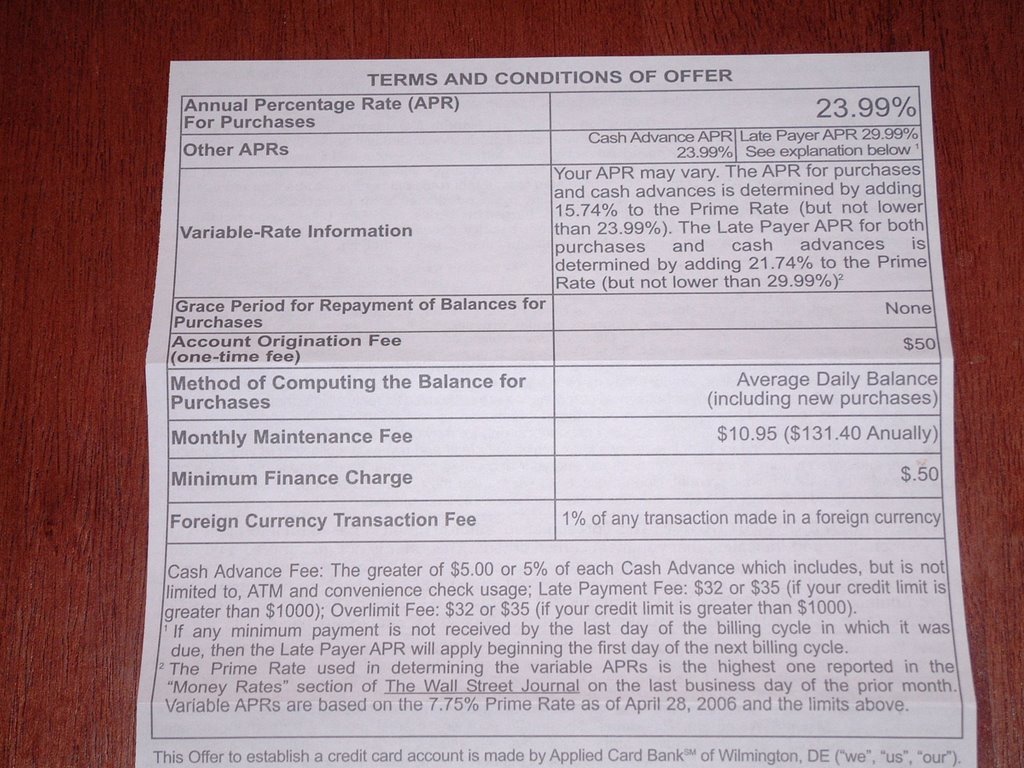
Anyway, about the bad credit card offer. The real question is WHO would order a card with these terms? I understand that there are people in serious financial straits. But, what kind of logic tells you that this type of credit card can help you? The details on this card say that there is a one-time "account origination" fee of $50. OK...it is going to cost me 50 bucks for someone to open an account for me? No thanks. Apparently, the cost of doing business must also be really hurting these folks, because they are also charging a monthly "maintenance fee" of $10.95 PER MONTH. Mind you, a good credit card should have no processing fee or monthly fee. An EXPENSIVE rewards card may have an annual fee of $65 or $80 per year, but you get back some rewards for that, and you get a substantial credit limit. Here, an annual fee of $131.40 rewards you with the privilege of running up new credit card debt. If you are planning on keeping a balance on the card (not recommended at all, but sometimes things happen, no?), they are going to hit you for 24% interest; miss a couple of payments and that shoots up to 30%. If the prime rate continues to climb (and the Fed Chair seems to indicate that it might), your interest rate will rise accordingly.

The letter that accompanied the above pictured flyer offered me a guaranteed credit limit of $500! Wow! I can pay over $130 per year for the privilege of borrowing all of $500. Actually, though, you don't get a $500 limit, either. Your first bill will include the $50 one-time fee and $10.95 for the first month's maintenance fee. So, the initial credit limit will be all of $439 -- and starting immediately, you better be making payments on time.

All I know is that this is some seriously expensive credit. Anyone who is in bad enough financial shape to need this credit card needs to really evaluate how bad they need any credit card.

So, who is this purveyor of crap? A fine company called Applied Card Systems. If New Yorkers needed any more reason to vote for Eliot Spitzer in the upcoming gubernatorial election, you should know that he filed a lawsuit against this fine company for predaory lending practices and slimy collection procedures. Personally, I was shocked to find this company is anything less than above-board with people. I am not one for big government, but any attempt to curb the hideous lending practices that many companies employ is welcomed.

Read the rest of this article...

31 May 2006

Stuff You Oughta Know About Student Loan Debt


Stop the presses...student loan debt is rising! Maybe this is news to some, but working in the admission office of a private university, it surely isn't shocking to me. I know students who have left college owing more than they would on a mortgage for a house. That said, while I believe in living a debt-free lifestyle, and I am working towards that goal, I do understand that student loans are the only way some people will ever finance their college education. Now, does this mean that there aren't better ways to manage that debt? No. But, given the overall sense of entitlement permeating the country, not many are willing to accept something that they perceive as second choice if there first choice is within their grasps - albeit with a touch of debt thrown in.

Government data says that the average 2003-o4 college graduate owed nearly $20,000 in student loans on graduation day. It is not unreasonable to think that this amount will rise significantly in the coming years, too. The government recently raised the amount that students can borrow, so naturally, this number is likely to rise. Frankly, the story is probably even worse than stated. It doesn't seem that this study takes into account the amount that parents borrow to send their kids to college, most likely in the form of PLUS Loans (Parent Loan for Undergraduate Studies). "Gap" or "alternative" loans also increase the total amount of money borrowed to pay for college. PLUS Loans and gap loans also carry higher interest rates than federal student loans, so they are an even more expensive option for paying for college.

Why the exponential spike in loans for college funding? The simplest answer is that the cost of attendance at both public and private universities is rising faster than the money available in gift aid (scholarships and grants, both from the institution and the state and federal governments). For example**, the amount available in Pell grant money to the students who theoretically need the most to attend college was $3,354 in 1990. In 2006, that amount is $4,050. Using the inflation calculator, you can figure that a Pell grant was worth nearly $5,200 in 1990 in current dollars. Not only has the Pell grant not kept up with the increasing costs of college education, it has effectively been CUT. So, if the poorest students have less access to education grants from the government, and still want to attend school, logic says that the money may have to come from loans.

How about the cost of attendance? If the aid is not increasing, surely the cost of attendance can't be going up much, right? Ummm....not exactly.

Average College Tuition and Fees 2005-06 versus 2004-05
  • At four-year private nonprofit institutions, tuition and fees average $1,190 more than last year ($21,235 versus $20,045, a 5.9 percent increase). Total charges average $29,026 ($1,561 more than last year's $27,465, a 5.7 percent increase).
  • At four-year public institutions, tuition and fees average $365 more than last year ($5,491 versus $5,126, a 7.1 percent increase). Total charges average $12,127 ($751 more than last year's $11,376, a 6.6 percent increase).
  • At two-year public institutions, tuition and fees average $112 more than last year ($2,191 versus $2,079, a 5.4 percent increase).

Average College Tuition and Fees 2005-06 versus 1989-90
  • At four-year private nonprofit institutions, tuition and fees average $9,235 more than 1989-90 ($21,235 versus $12,000). That makes for nearly a 77% increase, nearly 30% more than the inflation rate, in general terms over the same period.
  • At four-year public institutions, tuition and fees average $2,591 more than 1989-90 ($5,491 versus $2,900). That makes for an 89% increase, almost 40% more than the inflation rate, in general terms over the same period.
  • At two-year public institutions, tuition and fees average $1,091 more than 1989-90 ($2,191 versus $1,100). I don't even need to do the math to see that tuition almost doubled since 1989-90, while inflation overall stood at about 55%.

Given all this data, it is easy to see how people need to rely more heavily on debt to finance their education. Tomorrow, I will examine ways to manage this debt -- yes, I do believe that there is a way to do this!

**Data source: Paying for College

Read the rest of this article...

25 May 2006

Sometimes It's Hard to Not Be Judgemental

Since I have started writing and reading a number of blogs, I have found myself becoming increasingly judgemental about other people's issues -- especially financial ones. Believe me, I am in no place to judge anyone. My finances have been screwed for the last 10-plus years, and while I am making progress getting things together, I still do the kinds of things that other people would surely consider stupid.

Yet.....

It was hard not to read this week's USA Today article from their series "Couples and Their Money." I'll try to paint the picture for you, before I got judgemental.

Tim earns more than $100,000 a year as a senior bank loan officer; Caren makes about $65,000 a year as a physical therapist. Yet despite their ample salaries, they say they're "absolutely unable to put money aside, except with retirement accounts."
This inability to save also has them in over $400,000 worth of debt. I will admit that I don't know how anyone finds themselves in almost a HALF MILLION dollars worth of debt, but I still don't really think any less of them at this point -- they just spend more than they make, which doesn't really make them that much different than many other Americans. Further, almost 3/4ths of this debt is from the couple's primary home mortgage, so maybe the huge debt can just be attributed to keeping up with the Joneses? You would think, though, with a family income of $165k, a house with a $285k mortgage is not out of range, no?

Apparently, expensive dinners out, extravagant gifts given to one another and their son, and house fixer-upper projects (you would think that for $285k+, it would already BE fixed up, no?) all add up. While these may not be the financial choices I would choose to make, there is still no need to be judgemental, right?

How about this?

One thing they're not worried about is the cost of Edson's college education. They've decided that college expenses shouldn't derail their retirement savings.

"We basically told him that he can work his way through college," Caren says. "He can get loans; he can get a job. That's what makes the world go 'round."

And the nominees for Parents of the Year are....The Mayberry's. It's bad enough to dig themselves a financial hole, and teach their child that this is "normal,"and be so materialistic that having "stuff" trumps financial responsibility, but to set your ONLY son up for a possible financial hardship because of sheer selfishness is absolutely beyond me.

Families who make $165k per year should have no trouble funding one child's college education. Instead, because of their income, their son will have very limited access to anything except loans when it comes time to applying for financial aid. "Working his way through college" is a nice image, but why would you want to start you only child off behind the proverbial eight ball? Because it is more important to have a boat? Lovely priorities and a lovely message to send to your kid.

Others have commented on parent's responsibilities to their kids. The general concensus is that children are not entitled to extravagant weddings and expensive private school educations, but parents should take some control over their expenses to make sure that their children are at least somewhat taken care of when needed -- most seem to believe that it is not too much to expect parents to contribute at least the cost or the equivalent to a public university education, if it is realistically within the family's means. It still comes down to a measure of "to each his own," but just remember, your kids are the ones who will determine which old folks home you will be spending your golden months living in. Your call, Dad -- the nice, modern facility, or the crooked home that they showed on last week's '60 Minutes?'

If I were the Mayberry's, I don't know if I would want my son picking my 'home.'

Read the rest of this article...

24 May 2006

Paying the Stupid Tax


When I was broke - really broke - I grew accustomed to paying late fees on my accounts. At the time, I really didn't have much of a choice. I suppose, in retrospect (and knowing what I know now), I MAY have had some choices, but I either didn't know that I had a choice, or I simply ignored it. I always remembered a childhood friend who referred to these types of fees as the "Stupid Tax." The theory was simple -- if you were stupid enough to get yourself into the position where you couldn't pay all of your bills, then you should be taxed.

We can debate the validity of that argument, but it stuck with me.

It really stuck with me. I'm not sure if everyone who cannot pay their bills is always due to stupidity, but having the money to pay your bills, and just not doing it -- well, that reeks of stupidity. Due to my travel schedule, I find that I miss paying a credit card bill on time. This really sucks because I usually pay my balance in full, so I get hit with finance charges that I would not normally pay, as well as the $29 "You Missed Your Payment Deadline by a Day" Stupid Tax.

Even worse, having the money in one account, and spending it out of another -- well, stupidity reigns supreme again! Worserest of all (work with me....I am making a point), is having a check in your own possession that will cover all that you spent, but not depositing said check until after you are overdrawn truly raises the bar on the stupid-o-meter.

So, today, when I logged into my online banking statement, I found that I had been overdrawn (I have overdraft protection, so they transferred the money from my savings to pay the charges). I had some charges hit from last week's business travel and my monthly student loan payment. I guess I never noticed that my balance had gotten dangerously low -- I do like to keep about $500-1,000 reserve in the checking account, because I am not the most up-to-date person on all of the debits, credits, and pre-authorized monthly payments into and out of my checking account. The problem is that I never realized that my travel reimbursement check was sitting in my desk since last Friday.

Net result - $10 Stupid Tax paid to Wachovia so that they can better handle my money than I can. $10 is much better than the $29 to the credit card company, and a lot better than what would have been if they simply "bounced" the overdrafts, and then I had to pay Wachovia about $25 a pop PLUS each of the vendors -- three, for a total overdraft of about $60. Maybe I got a discount on my Stupid Tax.

Read the rest of this article...

19 May 2006

Old Business, Part II

Good Morning America** has been airing a series this month entitled "$100 a Day in May." You can see all of the video clips from that link. I have watched a few of them so far, and there have been some pretty good tips, but I don't know if any of these (even combined) are going to net anyone I know $3,100 ($100/day in May?).

As I view episodes that are worthy of comment, I will post on them....and I guess there is no better place to start than with the first installment. The idea is simple enough -- the government is holding your long lost and forgotten dough and all you need to do to claim it is step up and show your hand. I don't think that there's anything more simple than this kind of free money -- heck, it was already yours (at one time).

The story claims that (a) one in eight people have money held by their home State Treasury; and (b) the average claim amount that one is owed is over $900.

I have seen this type of story before on the news -- it seems like it is something that usually airs during sweeps month (hark, it's May!). They run the names of those with money to be claimed once a year in the local paper. It really does seem like the government and the media are doing their part to make you aware of this missing/found (guess it depends on how you look at it) money. Still, I have never bothered to check to see if I have any of this outstanding money. I guess I figured I was pretty on top of my finances and there would be no way that I could be missing money somewhere. There have been some times in my past when a "found" +/-$900 would have come quite in handy, and still I never checked.

Now, though, there is no reason for anyone not to check. All you need to do is consult with your home state's unclaimed property office, which is usually the State Treasurer. Still not sure if it is easy? How about a comprehensive web site that lays out each state's web site and physical address? Realistically, you are about four or five clicks away from finding out if you have any unclaimed property being held for you.

Why am I giving a hard sell on this? Well, guess who found some unclaimed property? It wasn't mine -- I already told you that I know my finances well enough to know that there are no outstanding pots of gold. My deceased father, however, has some unclaimed property in New York. I am not sure if I have access to all of the information I will need to claim it -- I know that I need a death certificate, which I do not have, and proof that he lived at the address attached to the claim, which I also do not have. I am pretty sure that I can get a copy of the death certificate from the State, but I don't know how I would prove that he lived at the address listed (which is the apartment in which we lived before we moved out to Long Island). I will admit -- I am pretty curious. I know that it could be 10 bucks -- but, I suppose it could be a few hundred, no?

I figure that the curiosity will kill me if I don't pursue this, so I may throw a few flares up and see what I can find. If there is anything worth posting, I will let you know. If it is a long lost lottery ticket, the name and focus of this blog will change drastically! My first new post will be titled "The Following People Can Kiss My Ruby Royal Red Keester..."

**Hat tip to Boston Gal's Open Wallet, an excellent daily read

Read the rest of this article...

28 April 2006

Just How Much is None?

The other night, I had dinner with a close friend. One of our conversation topics was debt consolidation and finances (yes, this friend is close enough that we can talk about such things and still leave friends). We have previously discussed my desire to become debt-free, and the small steps that I am taking to make that happen. His life is different than mine -- wife, kids, big house, car payments, better paying job, etc. I don't really know who is "winning" or even if we are keeping score, but he is happy, as am I -- and we are living our lives very, very differently.

I mentioned in the course of conversation that I have applied some of the principles I have learned from a personal finance radio program, The Dave Ramsey Show. I like Dave Ramsey -- well, I started to like Dave Ramsey a little more once I figured out that I had to weed out all of the God-related stuff. I believe that the personal finance ideals are good enough without the aspect of formal religion that I am willing to overlook that aspect of the show. Most days, he does not shove religion down your throat -- other days, it seems like I am listening to Rev. Jerry Falwell. Anyway, Ramsey preaches that debt-free means no outstanding debt except for a personal mortgage (15-year, fixed rate). When I told my friend this, he looked dumbfounded. He asked what are you supposed to drive? When I answered "a car that you can afford," he looked a little dumbfounded again.

He told me that he is resolved to having a mortgage (30-year, fixed) and at least one car payment -- maybe two. He looked at me like I had six heads when I said that I would never have a car payment again. Mind you, I am fortunate. I "inherited" an almost new vehicle last year -- no payments, and very reliable. If I am not able to save for a new car when I am ready to purchase one by the time this one needs to be replaced, I am doing something very wrong. He admitted that this was a sound plan, but he was skeptical that I would have the means, the fortitude or the stamina to make this plan work. I don't know how it will work out -- but, in a few years, one of us is going to be right.

I still need to pay off my outstanding student loans and a couple of hundred dollars in 0% credit card debt. When that is done, all that will remain is a relatively small mortgage. Frankly, I don't know when all this debt will paid off, but I know that I am on the right track.

On the other hand, I worry about my buddy. I tried to share what I am doing without preaching or telling him what to do. I know that not everyone makes the same decisions, but I have tried to outline for him all the questions he should ask before moving forward. Here is a guy who makes significantly more money than I do, and owes even more -- without the student loans. He borrowed money from his 401k plan to finance the closing costs on his recent home purchase. He told me at the time that he planned to repay the 401k loan with the proceeds from the sale of his previous home. To date, the old home has been sold, but the 401k loan is still outstanding. He argues that he is paying himself the interest on the loan balance -- and could pay off the remaining balance if he needed to change jobs or the loan was called due for some other reason. He cleared a substantial profit on his old home, and told me that he was planning on paying down his new mortgage with the proceeds from the sale. That never happened. He still has this money - and I think he is waiting for some Ralph Kramden-like scheme to parlay that money into something bigger -- but, the outstanding debt that he needs to deal with would just scare me to death.

We ended our conversation with him telling me about his plan to purchase a recreational boat. I know that it makes more sense to me to want to pay off the outstanding 401k loan, pay down the mortgage, save for the kids college education, pay off one of the cars, etc. than to buy a boat, but I hate to think of myself as judging someone else. Just doesn't seem like the way I would handle the situation myself. But, he does believe that because he doesn't have any credit card debt, that he is debt-free.

I know that there is a reason that I am single. Finding someone else who could think like I do about relationships is one thing - but, realizing that many people my age are still in full on accumulation mode and have different financial goals than I do, makes the thought of finding "that perfect someone" even more remote.

So, the question remains, how much money do you figure one can owe, and still consider themselves debt-free?

Read the rest of this article...
19 December 2005

Getting my financial house in order, Part II

Reading other people's personal finance blogs has been part boon and part bust for me. On the one hand, given my personal set of circumstances, I am not doing too badly in the Great Financial Game Show of Life. On the other hand, I also think that I realize that I don't make nearly enough money to ever live a comfortable retirement.

The Pros:

  • I own my own condo. I purchased it about six years ago -- before the huge real estate boom in this area. The best news is that I only owe about 1/3 of the property's market value. I guess that makes it a considerable asset, even if, relatively, it is not all that expensive a place.
  • I don't have a lot in the way of outstanding credit card debt (under $1,000). What's left are the remnants of when things weren't so good in life. I am making conscious efforts to pay down this debt -- all of which is at 0% interest.
  • I own my car(s) outright. I do need to get rid of the Seinfeld car (my black 1992 Saab convertible), but it does still have a positive value. The Town and Country that I inherited this year has an Edmond's value of over $10,000 -- and is surprisingly comfortable to drive.
  • This is the first year that my retirement accounts (old 401k from last job and current 403b now total over $25k) total more than my outstanding student loan balance (~$21k). I am psyched to know that the gap between the two will continue to grow.
  • The most brutal line items (a foreclosure, for one) have been removed from my credit report.
  • When you consider how relatively small my current income is, it is pretty amazing that I have been able to own my home, a loan-free car, and grow my savings -- all the while, not skimping out on the life's little things along the way. To be honest, I have no idea how I managed!


  • The Cons:
  • Without a serious upgrade in salary, I don't know that I will be able to meet my mid-range and long-range savings goals. I am doing OK, but there is only so much you can do on what I make.
  • I have too many accounts spread out -- and it appears to be costing me money. Actually, in some areas, I am hemorraging money. I have a TD Waterhouse brokerage account, which has a $25 quarterly inactivity fee. I also have a Regular IRA with Waterhouse that is also bleeding money. I opened the account when my last job didn't offer a retirement plan. I made a few deposits, but haven't really touched the money since. I am willing to bet that it has lost value.
  • Even though I recently opened an ING Direct savings account, the bulk of my savings are still sitting over at Wachovia, earning the pathetic 0.10% interest mentioned previously.


  • The Conclusions:
    I am not doing too bad, all things considered, but there is room for improvement. I spent the better part of the weekend installing Microsoft Money on my computer and importing and recording data. Hopefully, this will help me to identify accounts that need to be merged and/or closed, and target buget areas that could be trimmed or eliminated.

    I don't want to leave my current job (I have expressed that sentiment to those that matter numerous times now) for two reasons. First and foremost, I like what I do and the people with whom I work. I also like living here. As there are no other four year universities in my area, there are limited job opportunities, within my field, in this town. So, I just need to come up with a way to make a few more dollars on the side. I have tried selling stuff on eBay, but that is tough with my travel schedule. I have worked a few days as an indepent contractor for a friend who can provide me with a little bit of occasional high-dollar income. If I can pick up about 10 or so of those days, then maybe this workable?

    Not that this will generate a whole lot of income, but I have started a few new savings techniques. In addition to the ING account, I have opened checking and savings accounts with Bank of America, and I plan on participating in their "Keep the Change" program. They offer a match of everything you contribute to your savings account through this plan for the first three months you are enrolled. After the first three months, they will still match 5% of your contributions, up to $250/year.

    I also discovered this little gem: Of course, that blog references yet another article, so I will spare you the linking and the linking and the linking again -- but, the idea that I liked and have begun to employ is saving all of my $5 bills. I don't get too many of them to make a serious dent in my cash budget, and it seems like something that I can stick to.

    The battle rages on.

    Read the rest of this article...